Fence for Dogs: Choosing the Right Height and Spacing
A good dog fence is one of those “you notice it every day” home upgrades. You notice it when the kids can run out to grab a ball, when the dog settles without pacing, and when you stop doing mental math about escape routes every time the gate clicks shut. You also notice it fast if the fence is wrong.
Height and spacing are the two big variables, but they are not the only ones. A fence that looks tall enough on paper can still fail if there are climbable gaps, the dog can wedge through openings, or the dog is smart enough to exploit the smallest weakness. On the other hand, a fence that is overly tall or overly tight can be harder to live with, more expensive to install, and sometimes unnecessarily restrictive for the dog.
If you are weighing options and getting quotes from fence contractors in your area, this is the practical way I’d think about it when choosing height and spacing for a dog-focused setup, whether you are in suburban Melbourne or building on a larger block.
Start with the real job: what your dog will try to do
Most escape attempts are not random. They are usually tied to a motive: chase a cat, follow a scent, investigate the neighbour’s activity, or test boundaries when a person comes home. When a dog is determined, “good enough” becomes “not good enough” quickly.
Two details matter more than people expect:
A medium-sized terrier that can hop onto a low garden step will treat a fence like a challenge course. A calm dog that rarely jumps and stays within a set routine may never test the top edge at all. Meanwhile, a fence that blocks the inside route but leaves a tempting “ladder” on the outside can still lose the dog, even with strong panels.
When I talk with homeowners, I often ask what the dog does when the gate is open. Does the dog rush the gap, pause to look back, or immediately investigate the perimeter? That tells you where height and spacing needs attention.
Choosing the right fence height for dogs
There is no universal “one number fits all” height because dogs vary, but you can use practical ranges. The safest approach is to aim for a fence height that accounts for jumping ability, reach, and the dog’s tendency to climb.
The height rule that actually matters: can the dog get the top?
Dogs can “cheat” height in several ways:

- Jumping from the ground plus a bit of momentum
- Climbing on objects near the fence (even small ones)
- Stretching up from a gap in fencing or a weak rail area
- Using a fence style that gives paw and nose holds
For many suburban dogs, a fence height in the ballpark of 1.8 m to 2.0 m is often chosen because it covers a lot of everyday jumping behaviour. But I would not call that a guarantee for every dog. If you have a dog that is a frequent jumper, a young athlete, or a dog that grabs the top rail already, you need to treat “height” as a starting point, not an endpoint.
In Melbourne, a lot of fencing setups land in that range because it’s workable for neighbours, suits typical suburban block layouts, and matches common product sizes. That said, fencing contractors Melbourne households hire will still ask about the dog, not just the block.
Consider inside and outside elevations
One of the easiest ways to mess up a fence height calculation is ignoring where the dog can stand. If the ground on one side is higher, the effective height is lower. A dog that can stand on a slope, garden edge, or raised pavers outside the fence may only need to clear part of what you thought was full height.
A common real-world scenario goes like this: the fence is installed at a consistent height on the street side, but the yard slopes down. The dog, standing lower relative to the fence, might not care. Then you build or move a piece of furniture, a planter, or even a compacted soil mound near the fence. Suddenly, the dog gains a platform and the escape plan becomes feasible.
The same is true in reverse. If the dog side of the fence is higher, it may have an easier time reaching over.
Gates and corners are where height “changes”
Fence height is not only the panel height. Gates often introduce a different construction, different hardware, and sometimes slightly different top alignment. Corners can also be tricky. If the dog can access a corner where the structure has less rigidity or where there is a gap that changes with weather and settling, that is where the dog will investigate first.
When hiring a fence installer, ask how they will manage top alignment at gates and around posts. Small details here can be the difference between “never tries” and “tries every day.”
Spacing: the overlooked escape route
Spacing is the quiet culprit behind many fence failures. People focus on the height because it feels visible. Spacing is where a dog’s body can slip through, where claws can hook, or where the dog can reach the latch.
Spacing is also where different fence types behave very differently.
The practical spacing problem: nose, paw, and body size
Dogs do not need a full-body opening to escape. They might:
- Push a nose and test a gap
- Get a paw through and widen it
- Use a small gap to pull themselves through over time
- Reach through to unhook something like a latch or gate catch
For most dog owners, the key is to keep gaps small enough that the dog cannot insert any part of the body in a way that helps them escape. The exact “safe” gap depends on your dog’s build and motivation, but the principle is the same: smaller openings are better, especially at the bottom and around gate hardware.
Bottom clearance: dig-through and crawl-through
If there is one spacing area I treat as non-negotiable, it’s the bottom. Many fences leave a small gap under the panels. If your dog digs, that gap becomes a starting point. If your dog is a digger, I would treat bottom spacing and ground contact as part of the fence’s “security system,” not an afterthought.
There are a few common reasons fences end up with more bottom clearance than expected:
- Soil settles after installation
- Heavy rain washes soil away
- Neighbours’ landscaping changes the yard level
- Pets wear paths along the base over time
This is why regular checks matter, even after a great installation. If you have a dog that is clever, it will learn the fence’s weak zones fast.
Horizontal spacing vs vertical spacing
A fence with evenly spaced vertical rails might look secure until you realise the dog’s paws can climb using the rails as steps. Horizontal rails can be worse for climbing because they make a staircase effect. That does not mean horizontal fencing is always unsafe, but it changes the height and spacing conversation.
If you are choosing a fence company Melbourne homeowners use and you have a climber on your hands, ask specifically about climbability and how the rails are positioned. A fence contractor will often tell you which designs they see work best for dogs that jump and paw.
Matching fence style to dog behaviour
Height and spacing choices connect directly to fence style. Two neighbours can install “the same height” fence and get different results because of how the material and layout influence climbing, grabbing, and sneaking through.
Mesh-style fencing and wire panels
Mesh and wire-based fencing can work extremely well for dogs that do not climb aggressively, because the spacing is often small and consistent. The bigger concern is climbability and bottom clearance. If the dog can reach the top and pull its weight upward, it may climb even through mesh.
If you go this route, it’s worth paying attention to:
- Tight top and secure post caps
- Correct tension and alignment
- Bottom edge design and contact with the ground
Timber slat and paling fences
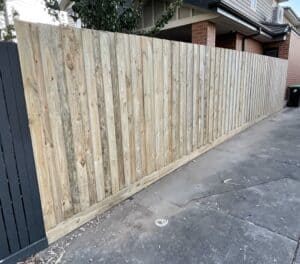
Timber palings can offer good security if the gaps are kept narrow and installation is consistent. But timber style sometimes introduces uneven spacing if boards warp over time or if the fence is not aligned tightly from the start. I have seen fences where one section is slightly more open due to how the boards sit, and that section becomes the dog’s “favourite door.”
For timber fences, the spacing check is not a one-time job. Weather and timber movement can change gaps. A good fencing installer will check and adjust as part of the install, but you should still plan on inspecting for gaps after storms and seasonal changes.
Solid or near-solid panels
Solid fences often make spacing less of an issue because there are fewer openings. However, “solid” does not automatically equal “secure” for all dogs. Dogs can still dig, jump, and test the gate. Also, solid fences can trap wind pressure, which can influence how panels hold over time if installation isn’t correct.
Solid or near-solid systems also raise a new question: if your dog can see something on the other side, the fence can create a barrier to movement but not always to excitement. That matters if your dog escapes due to stimulus, not because it can physically get out.
The gate is not just a door, it’s a weak point
Gate hardware, latch placement, and the way the gate meets the fence line can quietly undermine an otherwise excellent fence. For dog escapes, gates are frequently involved because they are:
- The easiest place to test and manipulate
- The area where alignment tolerance can be larger
- The point where a small gap becomes a bigger one if the gate swings
When you are comparing fence companies and fencing contractors, don’t only ask about the panel type. Ask how they detail the gate so the dog cannot get through or manipulate access.
Here’s what I’d pay attention to in the gate area, in plain terms:
- The latch height and whether the dog can reach it
- The gap between gate and post, and whether it stays consistent when the gate settles
- The bottom edge contact, especially if the dog digs or noses near the base
- Whether the gate is self-closing and how smoothly it closes under different conditions
If your dog is persistent, this is the moment to spend a bit more on good hardware and good installation. A fence installer who understands dog-focused security will usually suggest the right gate design without making it a complicated conversation.
Clearance inside the yard matters too
Some people only think about gaps that lead outside. Dogs can also escape through the inside perimeter if the yard layout supports it. For example, if there is a structure like a shed, pergola, or raised planter near the fence, the dog can climb those first and then reach over.
I’ve helped homeowners troubleshoot fences where the “escape route” was not a gap at all. It was the inside landscaping that created a ladder. When you raise the dog’s starting height, you reduce the effective fence height. That is why you should look for climb aids on both sides.
It also matters for long-term comfort. If the dog can climb near the fence, you may not only need more height, you may also need to manage how the yard is arranged so the fence can do the job you expect.
Realistic yard checks you can do in an afternoon
Before you commit to a specific height or fence type, do a quick assessment with your dog’s likely perspective in mind. You’re not trying to be an engineer. You’re trying to catch the “obvious but overlooked” problems.
- Walk the perimeter with your dog leashed, then look for the exact sections the dog fixates on
- Check for objects near the fence that can be climbed or pushed closer over time
- Measure the current dog platform height if the yard is uneven or sloped
- Inspect likely gap zones, especially around the bottom edge and gate corners
- After rain or soil shift, recheck bottom clearance, because it changes with time
If you are working with fence contractors, this kind of on-site observation helps you ask better questions. It also helps you compare quotes fairly, because you can identify whether the proposal addresses the same risk areas you observed.
Recommended height and spacing guidelines by dog type (practical ranges)
You can’t fully reduce this to a chart without pretending dogs are identical. Still, there are patterns that help.
Small dogs are less likely to jump a fence, but they are more likely to fit through gaps and learn “nose-through” tricks. A larger dog might not fit through the same space, but it might climb higher or dig deeper.
Active jumpers and climbers tend to need more attention to top security and the climbability of the fence style. Diggers and tunnelers need the bottom edge and ground contact treated like part of the fence structure, not a minor detail.
Medium and large dogs often escape because they learn the perimeter quickly, then exploit whatever is easiest. That usually means the weak point is a gate alignment issue or a bottom clearance gap that appears over time.
If you have a puppy or a young dog, you need to plan for growth and increased athleticism. A dog that is just starting to jump can become a confident jumper within months, especially if it gets repeated opportunities to test a fence.
Working with Fence contractors and fence installers in Melbourne
In Melbourne, many owners are choosing fences for multiple reasons at once: security, privacy, noise reduction, and neighbourhood aesthetics. That combination influences what gets installed and how quickly.
A good way to protect yourself when dealing with a fence company is to compare the details, not just the headline price or the fence height listed in a quote. Ask what materials and fasteners are used, how posts are set, and what they do to prevent gaps appearing later.
Also, when you deal with fencing contractors Melbourne, remember that local soil conditions and weather can affect how the fence settles. Ask whether the installer accounts for ground contact at the bottom and how they handle alignment at gates. A fence installer who has installed many dog-focused fences will often reference real issues they’ve seen, like panels shifting slightly after rain, or latch hardware needing a certain mounting approach.
If you are shopping around, it helps to use the vocabulary that matches the job. Instead of saying, “I need a fence for my dog,” be specific: “I need enough height to prevent jumping and enough spacing to prevent paw-through and nose-through escape attempts, and I’m especially concerned about gate gaps and the bottom edge.”
That’s the sort of question a fencing contractor should welcome because it points directly at what they can engineer.
A simple way to choose when you’re unsure
Sometimes you are between two fence styles or two heights. You can feel tempted to choose the cheaper option and “hope it works.” With dogs, hope is expensive.
If you’re unsure, treat your decision like a risk balance:
- If your dog’s behaviour is driven by curiosity and gap-testing, spacing matters more than a small height increase.
- If your dog is motivated to jump and climb, top edge control and climbability matter more than tiny spacing changes.
- If your dog digs, bottom edge security matters more than almost anything else.
- If your dog escapes through gate behaviour, upgrade the gate detail rather than only the panels.
That is how I would decide between options offered by fence contractors or a fence company, because it connects directly to what the dog actually does.
Trade-offs that come up in real installs
There is no such thing as the perfect fence for every household, because households have different priorities. You might want privacy, but you also want airflow for the yard. You might want strong security, but you also want a fence that blends visually with the home.
These trade-offs are usually tied to height and spacing:
- Taller fences can cost more and can create shade on garden beds.
- Tighter spacing can reduce escape risk, but some designs cost more and require more careful installation.
- Certain fence styles are more maintenance-heavy if you want them to stay tight over time.
- More solid barriers can create visual stimulation for some dogs, which affects behaviour even if the fence physically stops escape.
If you have a dog that paces at the fence line, the difference between seeing the street versus not seeing it might change how quickly the dog settles. That’s not about physical escape, but it still determines whether the dog stays content inside.
When height and spacing still fail: the edge cases
Even a well-chosen fence can fail if you miss the edge case. I’ve seen a few patterns over the years.
One is the “temporary” object problem. A homeowner might move a planter, a wheelbarrow, or a stack of timber near the fence for a few weeks, and it becomes a climb platform. If the dog escapes once, it learns that platforms are part of the escape toolkit.
Another edge case is gate sag after installation. It might not be a dramatic sag, but a slight change can create a gap the dog can exploit. That’s why gate hardware quality and correct installation are so important.
A third edge case is seasonal ground movement. Soil can shift after heavy rain or summer dryness. Bottom clearance can increase even if the fence panels are untouched. If you have a digger, those weeks after a storm are the time you check first.
What to ask before signing with a Fence contractor or Fence company
If you’re speaking with a fencing contractor, you want answers that sound practical, not vague. You want them to talk about the areas where dogs cause trouble: gates, bottoms, corners, and climbability.
Here’s a tight set of questions that usually gets you the information you need without turning the conversation into an interrogation:
- What is the panel height and how do you ensure top alignment at gates and corners?
- How do you handle bottom clearance, especially if the yard settles or after rain?
- Will the fence design allow climbing or paw-on support, and how do you reduce that risk?
- What hardware and latch style do you use on gates, and where is it mounted?
- If I later adjust the yard level or add a planter near the fence, how would that affect security?
This is the sort of detail that separates a fence installer who has done dog-focused installs from someone who only thinks about “fence height” in a general sense.
Choosing between options: a quick decision matrix
Sometimes it helps to compare two designs side by side in terms of dog-security outcomes. This is a simple way to think about it while you’re deciding, not a rule that replaces on-site judgement.
| Fence feature | Better for | Watch-outs | |---|---|---| | Tight vertical spacing (minimal gaps) | small dogs, gap-testing behaviour | climbing if the structure gives paw holds near the top | | Higher panel height | jumpers, boundary testers | effective height can drop on sloped ground or near elevated objects | | Solid panels | dogs that get distracted by seeing through | gates and bottoms still need tight detailing | | Better bottom contact | diggers and tunnelers | bottom clearance can change after soil movement, so inspect and adjust | | Gate gap control and latch height | persistent escape attempts | sag or settling can create new gaps over time |
If a fence proposal doesn’t mention gate detailing, bottom contact, and how they keep spacing consistent over time, you’re not comparing like with like.
Final thoughts on height and spacing, grounded in what dogs do
The biggest mindset shift is this: your dog is not trying to “go through the fence” as a concept. It is trying to do something specific, usually fast, usually motivated, and often by learning the one weak point that changes the odds.
Height deals with jumping and climbing ability. Spacing deals with gaps, reach, and the dog’s ability to insert a paw, widen a gap, or exploit a latch area. Bottom clearance is the quiet make-or-break detail for diggers. Gates are where alignment and hardware matter most.
If you take the time to observe your dog along the perimeter, then ask fence contractors Melbourne-style questions about gates, bottoms, and build consistency, you’ll end up with a fence that feels solid in the everyday way, not just in the measurement you wrote on paper.
And if you do choose a Fence company or fence installer that specialises in residential fencing, treat them like partners in the security logic. A good Fence contractor should be able to explain why their recommended height and spacing match your dog’s behaviour, not only the style of the fence. That’s the difference between a fence you installed and a fence that actually works.